 lop News
Ninety-two particles took a half-hour drive on Tuesday. It doesn’t sound like much until you learn what those particles were, and what would happen if the truck had hit a pothole.
For the first time in history, scientists have transported antimatter by road. A team from CERN’s BASE experiment loaded a trap containing 92 antiprotons onto a truck and drove it around the laboratory’s campus near Geneva — a 20-minute journey that represents years of engineering and a genuine breakthrough in how physicists can study the universe’s most elusive substance.
Antimatter annihilates on contact with ordinary matter. That’s not a metaphor — it’s physics. When an antiproton meets a proton, both cease to exist, converted instantly into energy. This makes storing antimatter fiendishly difficult. You can’t put it in a container, because the container is made of matter. Instead, you have to suspend it in a vacuum using magnetic and electric fields, and keep those fields stable enough that nothing bumps into anything.
Now imagine doing that on the back of a moving truck.
A Thousand Kilograms of Precision
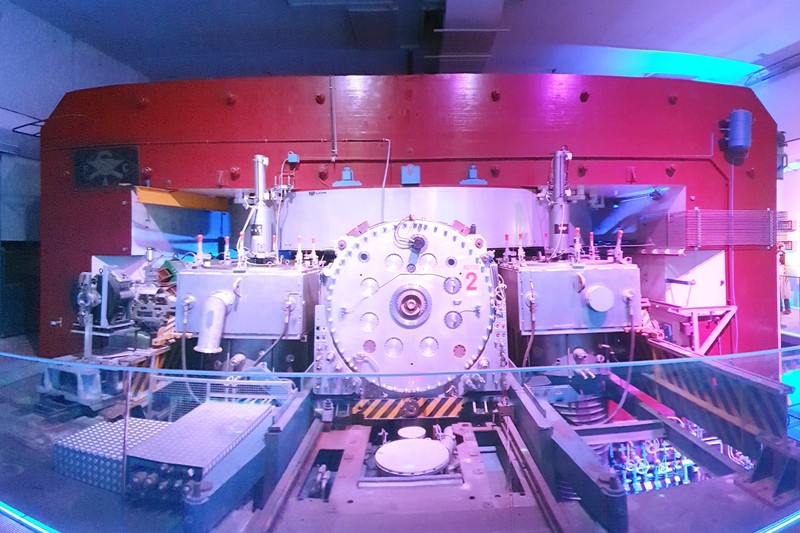
The device that made this possible is called BASE-STEP: a portable cryogenic Penning trap weighing roughly 1,000 kilograms (2,200 pounds). It contains a superconducting magnet cooled to -269°C with liquid helium, a vacuum chamber, and power reserves — everything needed to keep antiprotons suspended in isolation. The whole apparatus is compact enough to fit through ordinary laboratory doors and tough enough to survive the vibrations of road transport.
“The trap is supposed to contain these antiprotons no matter what,” CERN press officer Sophie Tesauri told the Associated Press. “If the truck stops, if it starts again, if it has to slam on the brakes — all that.”
The operation took about three hours from start to finish. The trap was slowly craned out of the lab, loaded onto the truck, driven around a 4-kilometer loop on CERN’s campus, and returned. When the team confirmed the antiprotons were still trapped — intact and ready for further experiments — there was applause and a bottle of champagne.
Why Move Antimatter at All?
CERN’s “antimatter factory,” powered by the Antiproton Decelerator and the Extra Low Energy Antiproton ring (ELENA), is the only place in the world where antiprotons can be produced, stored, and studied. But it’s not the ideal place to measure them.
“The machines and equipment in CERN’s ‘antimatter factory’, where BASE is located, generate magnetic field fluctuations that limit how far we can push our precision measurements,” explains Stefan Ulmer, spokesperson for the BASE collaboration. These fluctuations are tiny — about one billionth of a tesla, 20,000 times smaller than Earth’s magnetic field — but at the precision BASE requires, they matter.
Move the experiment to a magnetically quieter location, and those measurements could improve by a factor of 100 to 1,000.
That’s the vision: trap antiprotons at CERN, load them onto trucks, and deliver them to specialized laboratories across Europe. Heinrich Heine University in Düsseldorf, Germany, is the first planned destination — about eight hours by road under normal driving conditions.
The Hard Part Is Still Ahead
The current BASE-STEP trap can hold antiprotons for about four hours on internal power. The drive to Düsseldorf would take at least eight hours. The team is investigating whether a generator-powered cryocooler on the truck could extend that window.
There’s also the question of what happens at the other end. “The greatest challenge remains on arrival at the destination: to transfer the antiprotons to the experiment without them vanishing,” says Christian Smorra, leader of BASE-STEP. Heinrich Heine University’s receiving facility won’t be ready until 2029 at the earliest.
And there’s a broader constraint: much of CERN will close for upgrades to the Large Hadron Collider through the end of 2028, limiting opportunities for further transport tests.
A Universe-Sized Mystery in a Truck-Sized Box
The ultimate goal is to understand why we exist at all. According to the laws of physics, the Big Bang should have produced equal amounts of matter and antimatter — which should have promptly annihilated each other, leaving an empty universe. Instead, we live in a cosmos dominated by matter, with antimatter nearly absent.
Physicists suspect there are hidden differences between matter and antimatter that explain this imbalance. Finding them requires measuring antiproton properties — magnetic moment, charge-to-mass ratio — with extreme precision, then comparing them to protons. Any discrepancy, no matter how small, could point to new physics beyond the Standard Model.
“We are at the beginning of an exciting scientific journey that will allow us to further deepen our understanding of antimatter,” says Gautier Hamel de Monchenault, CERN’s director for research and computing.
For now, that journey is 4 kilometers long and takes 20 minutes. But for the first time, antimatter has left the building. Where it goes next — Düsseldorf, Hannover, laboratories not yet built — will shape the next chapter of particle physics.
Discussion (9)