 lop News
9.7 million tonnes of rare earth oxides. 27 million tonnes of fluorite. 37 million tonnes of baryte. And an antimony deposit that swells China’s proven reserves by half.
Beijing would like the world to know what it has underground.
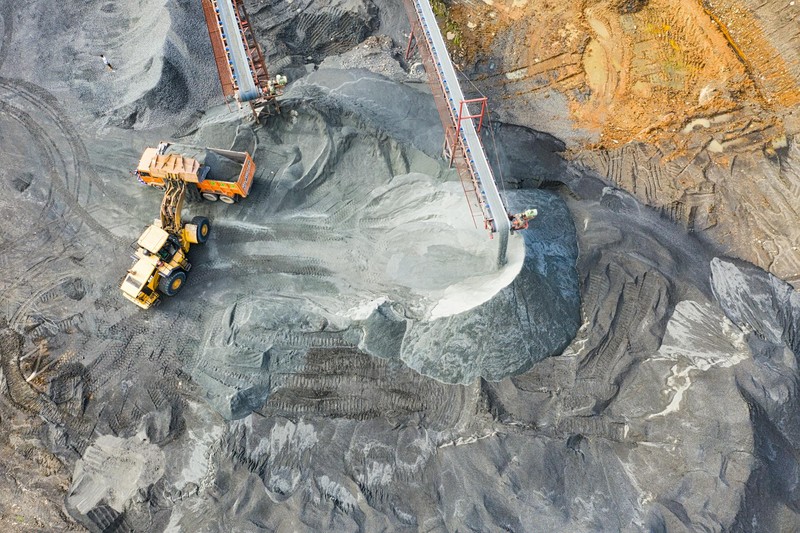
The Chinese government on Friday announced a suite of critical mineral discoveries at the Maoniuping mine in Sichuan province’s Mianning county and at a second site in Gansu province, according to state news agency Xinhua. The rare earth find alone — bringing Maoniuping’s total proven reserves to 10.4 million tonnes — ranks among the largest disclosed in decades. The fluorite and baryte deposits at the same site qualify as “super-large” under China’s classification system.
What’s in the Ground
Rare earths get the headlines, but the fluorite may matter more immediately. Fluorite — also called fluorspar — is a precursor material for semiconductor manufacturing and lithium-ion battery production. Baryte is indispensable for oil and gas drilling. Wang Denghong, director of the Institute of Mineral Resources at the Chinese Academy of Geological Sciences, called the fluorite and baryte finds “stunning” and noted that “without baryte, oil and gas exploration and production would grind to a halt, and the extraction of shale oil and gas would be out of the question.”
The antimony discovery in Gansu province’s Tanchang county adds 51,455 tonnes to China’s stockpile — a mineral used in flame retardants, batteries, and military munitions.
The Timing Is the Message
These announcements do not arrive in a vacuum. Beijing imposed export controls on seven rare earth elements and permanent magnets in April 2025, triggering factory shutdowns and supply scrambles across the American and European auto industries. January-February 2026 data shows US-bound rare earth permanent magnet exports fell 22.5 percent year-over-year, to 994 tonnes, even as EU-bound exports rose 28.4 percent — a selective squeeze that speaks volumes about where Beijing sees its adversaries.
Washington has responded with escalation of its own. In February, the Trump administration unveiled Project Vault, a $12 billion reserve fund to stabilize critical mineral prices, and the FORGE initiative, a coordinated trading bloc pitched to 54 countries at a Critical Minerals Ministerial. At the event, Washington signed bilateral critical minerals agreements with 11 countries, building on 10 similar pacts inked over the preceding five months.
China’s Friday announcement reads like a rebuttal. The subtext: you can build all the trading blocs you want; we have the deposits.
The Processing Bottleneck
Raw tonnage is one dimension. Processing capacity is the other — and it is where China’s leverage becomes genuinely difficult to replicate. Beijing controls roughly 70 percent of global rare earth mining output and close to 90 percent of refining and processing capacity, according to Fortune. That vertical integration, built over three decades of state-directed investment, means even countries sitting on their own deposits often ship ore to China for processing.
“Clearly, China is the leader, and the U.S. is far behind,” mining executive Mick McMullen told Fortune. “China has been at this for more than 30 years.” He estimated that building competitive processing capacity could take a decade — longer than any single administration’s term.
The Rare Earth Exchanges analysis notes critical unknowns: no production timelines have been disclosed for the new deposits, and no data on ore grade or economic viability has been released. Discoveries require infrastructure, permitting, and capital before they produce a single kilogram of refined material.
What the Ledger Shows
The strategic calculus is straightforward. Rare earths go into EV motors, wind turbines, and the guidance systems of precision munitions. Fluorite feeds chip fabs and battery plants. Antimony hardens ammunition. Every tonne Beijing adds to its proven reserves is a tonne that sits under sovereign control, available for export — or not — depending on the geopolitical weather.
With the one-year freeze on expanded export controls set to expire in November 2026, and US-China trade relations showing no signs of thaw, these announcements function as both geological disclosure and forward guidance. Beijing is telling Washington, Brussels, and Tokyo exactly how much leverage it holds.
The numbers, at least, are not bluffing.
Sources
- China reports ‘stunning’ critical minerals finds as hi-tech race with US heats up — South China Morning Post
- China flexes rare earth dominance with million-tonne discovery — MINING.COM
- China Announces New Mineral Discoveries — Strategic Signal, Not Just Geology — Rare Earth Exchanges
- Beijing’s dominance in rare earth processing leaves others scrambling to close the gap — Fortune
- The U.S. calls for trade bloc to counter China’s leverage in critical minerals — CNBC