 lop News
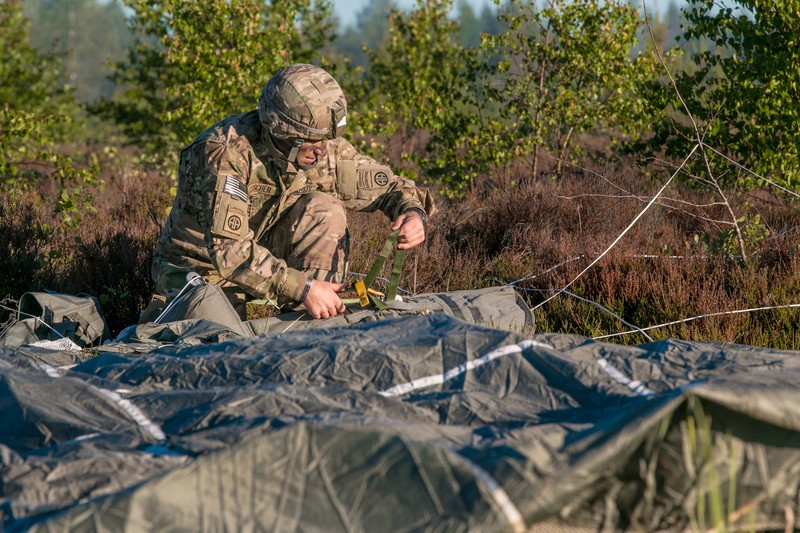
Brent crude futures jumped Tuesday, settling above $104 a barrel. The trigger wasn’t a missile strike or a tanker burning in the Strait of Hormuz. It was a report that the Pentagon plans to send troops from the 82nd Airborne Division to the Middle East.
The market reaction was instantaneous and unambiguous: investors are pricing in a wider war.
The deployment, first reported by the Wall Street Journal and confirmed by Reuters, would add to the thousands of Marines and sailors already dispatched to the region since the conflict began 25 days ago. Initial reports suggested roughly 3,000 troops, but more recent reporting indicates the deployment will be smaller—under 1,500 soldiers from the 82nd Airborne’s headquarters, staff, and some ground forces. The troops could deploy within 72 hours—the 82nd Airborne’s standard readiness window for a full brigade.
What the 82nd Airborne brings
The choice of unit matters. The 82nd Airborne, based at Fort Bragg, North Carolina, is not a garrison force. It specializes in parachuting into hostile or contested territory to seize and hold ground—a rapid-response hammer designed for forcible entry operations.
Defense officials have not specified where the troops would go or what mission they would be assigned. But the Wall Street Journal reported that the buildup could give President Donald Trump options for future operations, including reopening the Strait of Hormuz by force or seizing Iran’s strategic islands.
This is not a defensive deployment. It is an escalation signal.
The timing is telling. The reported troop movement comes just days after the Pentagon dispatched roughly 2,500 Marines aboard the USS Boxer, an amphibious assault ship, to the region. That was the second Marine expeditionary unit sent to the Middle East in quick succession. Add the 82nd Airborne, and the United States is assembling the kind of force structure typically associated with offensive operations—not deterrence.
The Hormuz calculus
The Strait of Hormuz remains effectively shuttered. Before the war, roughly 20 million barrels of oil and petroleum products passed through the chokepoint each day—about a fifth of global supply, worth an estimated $600 billion annually. Iran has threatened to attack any vessel linked to the United States, Israel, or what it calls “participants in the aggression.”
On Tuesday, the Financial Times reported that Iran had sent a letter to the International Maritime Organization stating that “non-hostile vessels” would be allowed to transit if they coordinated with Iranian authorities. The offer is conditional and appears designed to drive a wedge between Western powers and neutral shipping nations—not to reopen the waterway.
At least 21 vessels have been hit or targeted since the conflict began, according to an AFP tally. Eight people have been killed; four remain missing. Hundreds of ships remain stranded in the Persian Gulf, unable or unwilling to run the gauntlet.
Macquarie, the global brokerage firm, warned that Brent crude could reach $150 per barrel if the strait remains closed through April. Even if tensions ease, the firm expects a price floor of $85–$90 and a natural drift back toward the $110 range—levels far above pre-war norms.
The diplomatic theater
The military buildup is unfolding against a backdrop of diplomatic confusion.
President Trump has insisted that talks with Iran are underway “right now” and that Tehran has offered an energy-related gift. He told reporters that Iran had “agreed they will never have a nuclear weapon” and that the United States had “won” the war.
Iran has denied any such discussions exist.
Deputy Speaker Ali Nikzad told the semi-official Fars News Agency that the Strait of Hormuz would not return to normal operations and ruled out talks with Washington. The contradiction is stark: the American president claims progress toward a deal; Tehran says there is no process at all.
Meanwhile, Israel has continued its military offensive. And Iran’s Atomic Energy Organization reported Tuesday that a projectile had struck the grounds of the Bushehr nuclear power plant—though it said the incident caused no damage or casualties.
International alarm
Thirty nations—including the United Kingdom, France, Germany, Japan, Canada, and South Korea—signed a joint statement on March 19 condemning Iran’s “de facto closure” of the Strait of Hormuz and calling for an immediate moratorium on attacks on civilian infrastructure.
The statement welcomed “preparatory planning” by unspecified nations to ensure safe passage through the strait—diplomatic code for military options. It also noted the International Energy Agency’s decision to authorize a coordinated release of strategic petroleum reserves.
The message was clear: the international community views Iran’s actions as a threat to global economic stability. But the response so far has been rhetorical and economic, not kinetic. That may change if the strait remains closed and prices continue to climb.
What comes next
The 82nd Airborne deployment does not guarantee a ground war. Trump has said repeatedly that he has no immediate plans to put American boots on Iranian soil. But he has also declined to rule it out—and has criticized NATO allies for their reluctance to contribute militarily.
In a Friday interview with Fox News, Trump said he needed “numbers” to reopen the Strait of Hormuz. The 82nd Airborne provides numbers.
The force could be used to reinforce US positions, protect American personnel, or serve as a deterrent. It could also be used to seize Kharg Island—Iran’s main oil export terminal—or to conduct operations against Iranian coastal defenses. The Pentagon has not decided. But the capability is being positioned.
Oil markets understand what that means. Brent crude is up nearly 70 percent this year. If the Strait of Hormuz remains blocked through spring, $104 may look like a bargain.
The United States is preparing for escalation. Whether that preparation becomes action—and whether Iran blinks before it does—remains the central unknown of a conflict that shows no signs of de-escalating.
Discussion (12)