 lop News
Eleven years. Eleven consecutive heat records. One generation.
On Monday, the World Meteorological Organization confirmed that 2015 through 2025 were the hottest years ever recorded. Last year ranked second or third globally, averaging about 1.43 degrees Celsius above pre-industrial levels — slightly cooler than 2024’s record of 1.55°C, but only because a natural cooling pattern in the Pacific temporarily masked the underlying trend.
Strip away La Niña’s influence, and the trajectory is unambiguous. The pattern is now so consistent that the WMO has essentially run out of new superlatives.
“The global climate is in a state of emergency,” said UN Secretary-General António Guterres. “Every key climate indicator is flashing red.”
A new metric enters the record
For the first time, the WMO included Earth’s energy imbalance in its flagship State of the Global Climate report. The metric measures the gap between solar energy entering the atmosphere and heat escaping back into space. In a stable climate, those numbers are roughly equal.
Not anymore.
Greenhouse gas concentrations — carbon dioxide, methane, and nitrous oxide — have reached their highest levels in at least 800,000 years, according to the report. Carbon dioxide alone hit its highest atmospheric concentration in at least 2 million years in 2024 and continued rising in 2025. These gases act like a planetary blanket, and the energy imbalance reached a record high in 2025.
“Human activities are increasingly disrupting the natural equilibrium,” said WMO Secretary-General Celeste Saulo. “We will live with these consequences for hundreds and thousands of years.”
The ocean’s burden
More than 91 percent of that excess heat ends up in the oceans. Ocean heat content broke records for the ninth consecutive year in 2025, with the rate of warming more than doubling between 2005 and 2025 compared with the previous four decades.
The consequences are far-reaching: degraded marine ecosystems, bleached coral reefs, weakened carbon absorption, and stronger tropical storms. Three billion people rely on seafood for protein. Rising temperatures are shrinking fish populations and disrupting food chains.
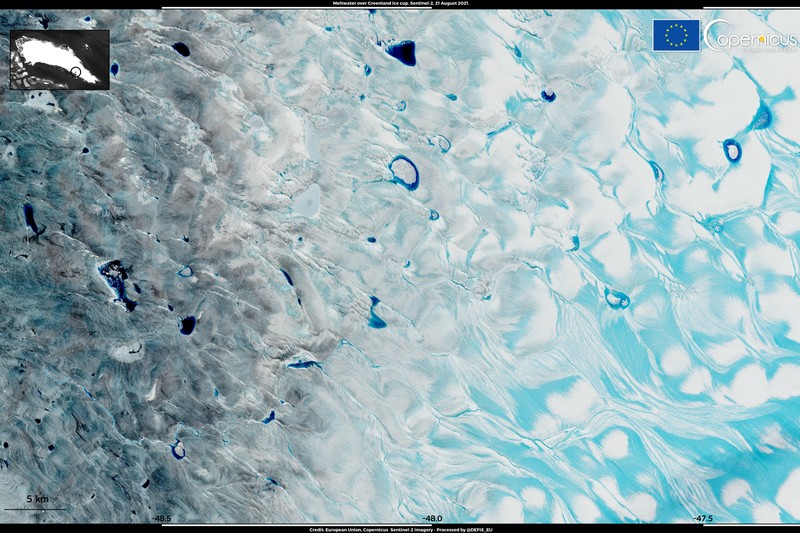
Global sea levels now sit about 11 centimeters higher than when satellite measurements began in 1993, driven by thermal expansion and melting ice. The Arctic saw sea ice extent at or near record lows. Glaciers, which supply water to roughly 2 billion people, continued their retreat.
Locked in
Perhaps the most sobering finding is the timescale. Ocean warming and sea level rise are projected to continue for centuries, the WMO stated. Even significant emissions reductions today would not halt ocean warming this century due to the energy imbalance already built into the system.
The warming pattern could accelerate further. After La Niña conditions fade, El Niño — which amplifies global temperatures — could return by late 2026 or early 2027, potentially driving another sharp temperature spike.
WMO Deputy Secretary-General Ko Barrett described the outlook as a “dire picture.” The indicators, she acknowledged, are “not moving in a direction that provides for a lot of hope.”
The security dimension
The report arrives amid war in the Middle East and volatile fuel prices. Guterres connected these dynamics directly to the climate crisis.
“Our addiction to fossil fuels is destabilizing both the climate and global security,” he said.
The Paris Agreement’s target of limiting warming to 1.5°C remains technically within reach but increasingly unlikely. Global emissions reached record highs in 2025. Extreme weather events last year — heatwaves, wildfires, flooding, drought, and tropical cyclones — caused thousands of deaths and billions in economic losses. The California wildfires in January 2025 alone caused more than $60 billion in damage, the costliest such event ever recorded.
“When history repeats itself 11 times, it is no longer a coincidence,” Guterres said. “It is a call to act.”
The climate has already changed. The question now is how much more change gets locked in — and for how many generations.
Sources
- Earth heat hits record in 2025 as UN warns warming will last thousands of years — France 24
- Earth’s climate more unbalanced than ever, WMO warns — Deutsche Welle
- State of the Global Climate 2025 — World Meteorological Organization
- The latest world climate report is grim, but it’s not the end of the story — The Conversation