 lop News
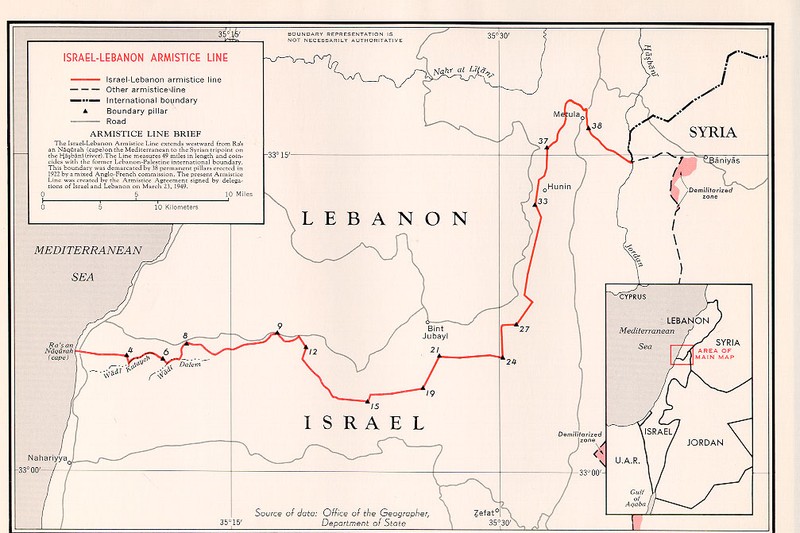
The Litani River winds through southern Lebanon roughly 30 kilometres from the Israeli border. For four decades, it has represented the outer limit of Israel’s security ambitions in its northern neighbour — the line beyond which Israeli forces withdrew in 2000 after an 18-year occupation, and the boundary established by UN Security Council Resolution 1701 to end the 2006 war.
Now Israel is crossing it again, and this time it plans to stay.
On March 24, Defence Minister Israel Katz announced that Israeli forces would establish a “security zone” extending to the Litani River, placing a large swathe of southern Lebanon under indefinite military control. The announcement transforms a conflict that began as cross-border exchanges of fire into something closer to the Gaza campaign: territorial occupation, mass displacement, and no clear timeline for withdrawal.
“The principle is clear,” Katz said in a briefing with defence chiefs. “There is terror and missiles, no homes and no residents — and the IDF is inside.”
The occupation, Katz explained, would be modeled on the Israeli approach to Rafah and Beit Hanoun — population centres in the Gaza Strip that have been largely destroyed by air strikes and remain under Israeli military control.
A Red Line Crossed
The Litani River has shaped Israeli strategic thinking since the 1982 invasion of Lebanon, when Israeli forces pushed north to the river in an attempt to root out Palestinian militants. That occupation lasted 18 years and ended only when Israel withdrew unilaterally in 2000, having failed to destroy Hezbollah — the Shia militia that emerged in direct response to the Israeli presence.
UN Security Council Resolution 1701, which ended the 2006 Israel-Hezbollah war, mandated that the area south of the Litani remain free of armed groups except for the Lebanese military and UN peacekeepers. That arrangement held, imperfectly, for nearly two decades. Israel is now abandoning it entirely.
The immediate trigger for the escalation was Hezbollah’s firing of rockets into northern Israel in retaliation for the killing of Iran’s supreme leader — part of a pattern of near-daily Israeli attacks on Lebanon despite a ceasefire agreement reached in November 2024. But the scope of Israel’s response — destroying bridges, seizing territory, and barring civilians from returning — suggests war aims that extend beyond degrading Hezbollah’s capabilities.
What Occupation Means
The humanitarian implications are severe. According to the Lebanese health ministry, more than 1,000 people have been killed in Lebanon since the latest escalation, including at least 118 children and 40 health workers. More than a million people have been displaced — roughly one-fifth of Lebanon’s population.
Katz made clear that those displaced from southern Lebanon will not be permitted to return. “They will not return south of the Litani River until security is guaranteed for the residents of the north” of Israel, he said.
Israeli forces have already destroyed five bridges that the military said were “used by Hezbollah for the passage of terrorists and weapons.” The targeting of infrastructure, combined with the demolition of houses in border villages that Katz described as “terrorist outposts for all intents and purposes,” points to a sustained campaign to make the security zone uninhabitable.
Lebanon’s President Joseph Aoun condemned the Israeli plans as a “policy of collective punishment against civilians” — a charge that carries weight given the scale of displacement and the explicit linkage between Hezbollah’s actions and the denial of return to civilians.
From Buffer Zone to Annexation?
The more ominous signal came one day before Katz’s announcement, when Finance Minister Bezalel Smotrich called for the effective annexation of southern Lebanon.
“The Litani River must become our new border with the State of Lebanon — just like the buffer line in Gaza,” Smotrich said in a speech on March 23. The comparison is revealing: Israel has made clear that its security zone in Gaza is intended to be permanent, and Smotrich’s framing suggests the same fate may await southern Lebanon.
Smotrich’s position is not official government policy, but as a senior cabinet minister with significant influence over settlement and land policy, his statements carry weight. The coordination between his annexation rhetoric and Katz’s occupation announcement — separated by 24 hours — raises the question of whether the military operation is intended to create facts on the ground that could eventually support territorial expansion.
Lebanon’s Sovereignty Under Assault
The occupation strikes at whatever remains of Lebanese state sovereignty. Southern Lebanon is the heartland of the country’s Shia Muslim community and Hezbollah’s main support base. By holding the territory indefinitely, Israel is effectively partitioning Lebanon — creating a zone where the Lebanese government has no authority and where Israel serves as the de facto governing power.
Lebanon’s government has vowed to disarm Hezbollah, but the group has refused to discuss the future of its weapons. Katz accused the Lebanese government of having done “nothing” — a charge that ignores both Hezbollah’s entrenched power and the weakness of a Lebanese state that has been without a fully functional government for years.
The occupation puts the Lebanese government in an impossible position. It cannot disarm Hezbollah by force, and it cannot compel Israel to withdraw. Its territory is being seized, its citizens displaced, and its infrastructure destroyed — and it lacks the capacity to resist on any front.
A Regional War Expands
The southern Lebanon occupation must be understood as part of a broader regional conflagration. Israel is now conducting sustained military operations on three fronts: Gaza, where the war continues; the West Bank, where raids and settlements have intensified; and now Lebanon, where a buffer zone has become an open-ended occupation.
The connection to Iran runs through all of this. Hezbollah’s rocket fire was retaliation for the killing of Iran’s supreme leader — an assassination that marked a major escalation in Israel’s shadow war with Tehran. Iran’s network of regional proxies, from Hezbollah to the Houthis in Yemen, has been steadily drawn into direct confrontation with Israel.
What began as a war to degrade Hezbollah’s missile arsenal and secure Israel’s northern border has become something larger: an experiment in territorial control that echoes the Gaza campaign. The question now is whether the international community will treat it as a temporary security measure or as what it increasingly resembles — a permanent redrawing of borders through military force.
The Litani River was supposed to be the line that contained the conflict. Israel has just crossed it, and no one can say when — or whether — it will retreat.
Discussion (13)