 lop News
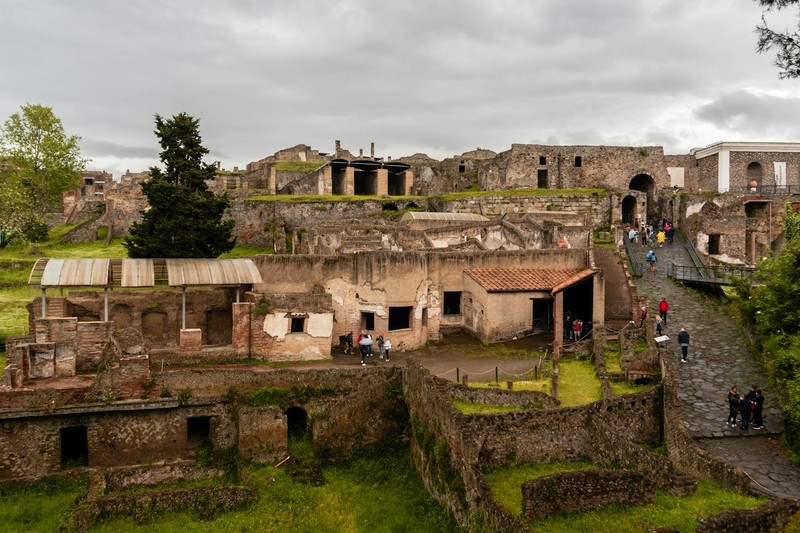
No physical example of a polybolos has ever been recovered. The ancient Greek repeating catapult exists only in the technical writings of Philo of Byzantium — and now, possibly, in stone.
A team led by Adriana Rossi at the University of Campania has identified distinctive damage patterns along the northern stretch of Pompeii’s fortified walls that they argue were left by this weapon. Their findings, published in the journal Heritage in March 2026, describe tight, radial clusters of quadrangular cavities near the gates of Vesuvius and Herculaneum — impact marks whose shape and spacing match military darts from the period and nothing else in the known Roman arsenal.
The damage dates to 89 BCE, when the forces of general Lucius Cornelius Sulla besieged the city. Less than two centuries later, Vesuvius buried Pompeii under meters of ash, preserving those battle scars in near-perfect condition.
The polybolos itself was a mechanical marvel attributed to Dionysius of Alexandria, a Greek engineer working in Rhodes around the third century BCE. A torsion-powered device with a chain drive and gear system, it automatically loaded bolts into firing grooves and launched them in rapid, repeating bursts — the ancient world’s closest analog to a belt-fed machine gun.
Rossi’s team used close-range photogrammetry, structured-light 3D scanning, and laser scanning to build high-resolution models of the impact sites. “The unequivocally radial configuration of the closely spaced impacts observed at Pompeii makes it reasonable to hypothesize the use of an automatic scorpion intended to strike archers,” the paper states.
It is not proof. But it is the most compelling physical trace yet of a weapon that, until now, lived only on the page.