 lop News
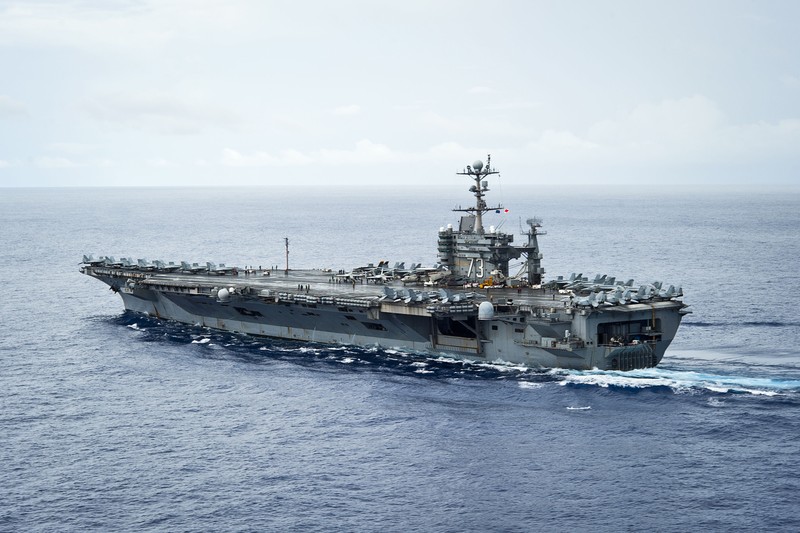
Three weeks into the Iran war, Pentagon planners are confronting an uncomfortable truth: the United States Navy, for all its overwhelming firepower, cannot quickly reopen the Strait of Hormuz. The waterway through which one-fifth of global oil supplies once flowed remains effectively blocked. Zero ships transited it in the past 24 hours, compared to more than 100 on a normal day.
This is not for lack of effort. US Central Command reports that American forces have struck more than 7,000 targets in Iran and destroyed 17 Iranian warships and over 120 vessels overall. Defense Secretary Pete Hegseth has described the campaign in terms of sustained success. Yet the strait stays closed, oil prices hover above $100 per barrel, and administration officials privately acknowledge that reopening the key waterway is, in the words of multiple sources who spoke to CNN, “a problem without a clear solution.”
The Escort Problem
For decades, American naval doctrine assumed that carrier strike groups and air power could guarantee freedom of navigation through critical chokepoints. The current conflict has tested that assumption and found it wanting.
The difficulty is geographical and tactical. Iran has spent two decades developing what analysts call “asymmetric naval capabilities” — an arsenal of roughly 5,000 to 6,000 mines, midget submarines, fast attack craft, and coastal missile batteries designed specifically for this scenario. As the Brookings Institution noted this week, the very act of sending warships into the strait moves expensive American platforms perilously close to Iranian shores, where remaining Iranian weapons systems have their best opportunity to strike.
“If we put forward an escort campaign, and that campaign fails, you’ve escalated the fear factor rather than reducing it,” Brookings analysts observed. Markets, they noted, are reacting not just to supply shortages but to the demonstrated inability of the world’s most powerful navy to secure a 21-mile-wide waterway against a determined regional adversary.
What the War Has Cost
The financial burden has been staggering. According to the Center for Strategic and International Studies, the first 100 hours of operations cost the United States approximately $3.7 billion — mostly unbudgeted. The economic shock waves have spread globally. The International Energy Agency coordinated the largest emergency oil release in its history, 400 million barrels, but prices have not retreated.
The human and material strain is also visible. The USS Gerald R. Ford, one of two aircraft carriers deployed to the region, experienced a fire in its laundry section this month — the Navy said it was not combat-related, but the incident underscored the stress of extended high-intensity operations. Iranian forces fired ballistic missiles toward the USS Abraham Lincoln in the Indian Ocean; the missiles fell short, but the attempt itself was unprecedented.
Strategic Reckoning
What troubles Pentagon planners is not that the war is being lost — by conventional metrics, it is not. Iranian air defenses have been degraded, missile launchers destroyed, naval infrastructure hammered. The joint US-Israeli campaign has killed Iran’s supreme leader and dozens of senior military figures.
The problem is that the campaign’s original assumptions have not held. The decapitation strike that killed Ayatollah Ali Khamenei was predicated on the belief that eliminating leadership would precipitate government collapse. Instead, Iran’s decentralized command structure — specifically designed to survive exactly this scenario — has continued functioning. A new supreme leader has been appointed. Missile barrages continue. The strait remains closed.
“The fundamental advantage Iran has is that knowledge can’t be bombed away,” a European diplomat told CNN, referring to Iran’s nuclear program. The same principle applies to its naval doctrine. Mines can be laid by small boats from countless coastal inlets. Missiles can be fired from mobile launchers that hide in civilian infrastructure. An adversary does not need to win at sea to impose catastrophic costs on the global economy; it only needs to deny the United States a quick victory.
The Pentagon is now weighing options that would have seemed unthinkable before February 28 — including the deployment of ground troops to seize Kharg Island, the hub for 90 percent of Iran’s oil exports. Such an operation would be, in the words of one US official, “very risky.” Iranian forces can reach the island with missiles and drones. But the fact that such options are being seriously discussed reveals how thoroughly the original assumptions of a limited, surgical campaign have unraveled.
A president who campaigned on ending America’s forever wars now faces a conflict with no easy off-ramps, having exposed the limits of the very sea power that was supposed to make such conflicts manageable.
Sources
- War with Iran has exposed American fragility at sea — Financial Times
- Why Iran’s disruption of the Strait of Hormuz matters — Brookings Institution
- Inside Trump’s most difficult war decision yet — CNN
- How Trump’s attack on Iran risks dragging US into Middle East ‘quagmire’ — Financial Times
- Strategic oil release may calm markets but cannot fix Hormuz disruption — Al Jazeera
- Middle East Special Issue: March 2026 — ACLED