 lop News
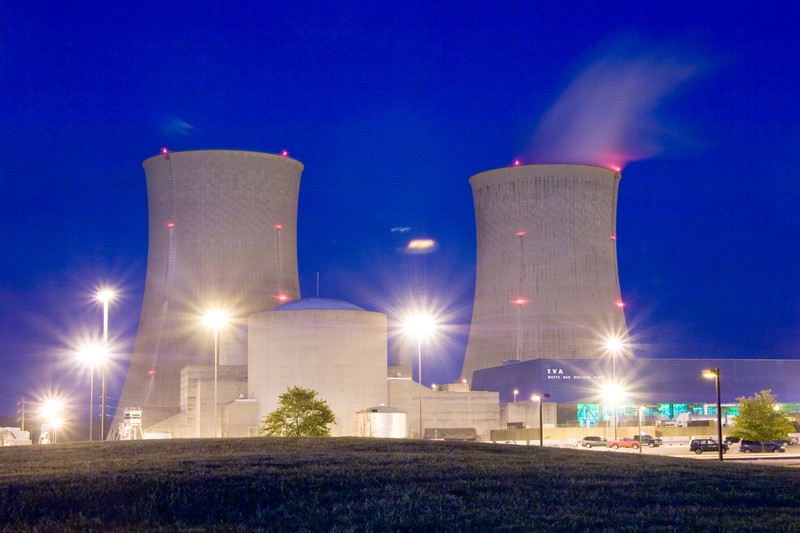
Forty billion dollars buys you a lot of nuclear reactors. In Tennessee and Alabama, specifically, where GE Vernova and Hitachi plan to build fleets of BWRX-300 small modular reactors under a deal announced Thursday by President Trump and Japanese Prime Minister Sanae Takaichi. Not a single SMR has yet fed a watt into the American grid, but that hasn’t stopped either government from treating the technology as a sure bet.
The timing is difficult to ignore. The announcement landed the same week U.S.-Israeli airstrikes continued to pound Iran’s Natanz enrichment facility — the very infrastructure that makes nuclear energy possible, repurposed for weapons and now cratered from the air. Washington, in other words, is simultaneously destroying one country’s nuclear program and bankrolling another’s reactor exports. The Pentagon and the Commerce Department working different sides of the same atom.
Follow the Fund
The reactor deal draws from a $550 billion U.S.-Japan investment fund established as part of a broader trade agreement that saw Trump lower auto tariffs and other levies on Japanese goods. A second tranche announced this week added up to $73 billion in commitments, split between the nuclear project and $33 billion for natural gas power plants in Pennsylvania and Texas.
A White House official said the investments would “stabilize electricity prices and bolster US leadership in global technology competition” — a nod to the insatiable power demands of artificial intelligence data centers that have made reliable baseload energy a boardroom obsession. Japanese suppliers IHI Corp., Japan Steel Works, and Tamagawa Seiki will provide components and machinery, making the deal as much an industrial supply chain play as an energy one.
For Tokyo, the logic is less about AI and more about survival.
Ninety Percent Through a Chokepoint
Japan sources over 90% of its crude oil imports from the Middle East, nearly all of it transiting the Strait of Hormuz. Since U.S.-Israeli strikes began on February 28, Iran has imposed a selective blockade on the waterway, initially threatening to set “ablaze” any transiting vessel. The chokepoint has functioned as effectively closed for most commercial traffic.
But not for everyone. Iranian Foreign Minister Abbas Araghchi announced on March 21 that Tehran would permit Japanese vessels to pass. “We have not closed the strait,” Araghchi said. “It is closed only to ships belonging to our enemies, countries that attack us.” Ships from Pakistan, India, and Turkey have already transited; China is negotiating passage for crude and LNG carriers.
That Iran singles out Japan for preferential treatment while Tokyo stands shoulder-to-shoulder with Washington on investment pledges is the quiet subplot of the whole summit. Takaichi has declined to commit forces to any Hormuz security operation, telling parliament that Tokyo had received “no official request” from the United States. She is, in diplomatic terms, keeping one foot on each bank of a widening river.
Oil in the Basement, Reactors on the Drawing Board
The nuclear deal sits alongside another Takaichi initiative: stockpiling American crude oil on Japanese soil. Officials said the reserves would be released domestically in emergencies and resold to Asian neighbors during normal periods, positioning Japan as a regional supply hub. Japan currently gets roughly 4% of its oil and 6% of its liquefied natural gas from the United States — numbers Takaichi clearly wants to increase.
Taken together, the moves sketch a coherent if ambitious strategy: reduce dependence on Gulf hydrocarbons through American nuclear technology and American crude, while maintaining just enough diplomatic goodwill with Tehran to keep tankers moving through Hormuz in the meantime.
Whether the reactors materialize is another question. The BWRX-300 design still requires regulatory approvals, and the history of nuclear construction in the United States is a graveyard of cost overruns and missed deadlines. The $40 billion figure is an upper estimate, not a contract price.
But for a country that watched its oil lifeline close overnight in late February, “up to” is a more comfortable phrase than “none at all.”
Sources
- Trump takes friendly tone with Japan’s Takaichi to avoid isolation on Iran — Nikkei Asia
- Trump, Takaichi unveil $40 billion US nuclear project — MINING.COM / Bloomberg
- Iran says it will allow Japanese ships to transit the Strait of Hormuz — Al Jazeera
- Strait of Hormuz: Which countries’ ships has Iran allowed safe passage to? — Al Jazeera
- Japan may stockpile US oil domestically, PM says — Reuters via EnergyNow