 lop News
Sri Lanka has put schools on a four-day week. Pakistan has imposed four-day work weeks as fuel prices surge. Bangladesh has shuttered universities. South Korea has imposed its first fuel price cap in nearly three decades. And China — the world’s largest energy consumer — has barely flinched.
Three weeks into the Strait of Hormuz closure, the contrast between China and its Asian neighbors tells a story that has less to do with environmentalism and more to do with money. Specifically, about $500 billion of it, spent on energy infrastructure in 2025 alone.
The Doctrine
In September 2021, Xi Jinping visited the Changqing oilfield and reportedly declared that China must hold its energy supply “in its own hands.” At the time, it sounded like boilerplate — the kind of thing leaders say at photo-ready industrial sites. In retrospect, it was a strategic directive.
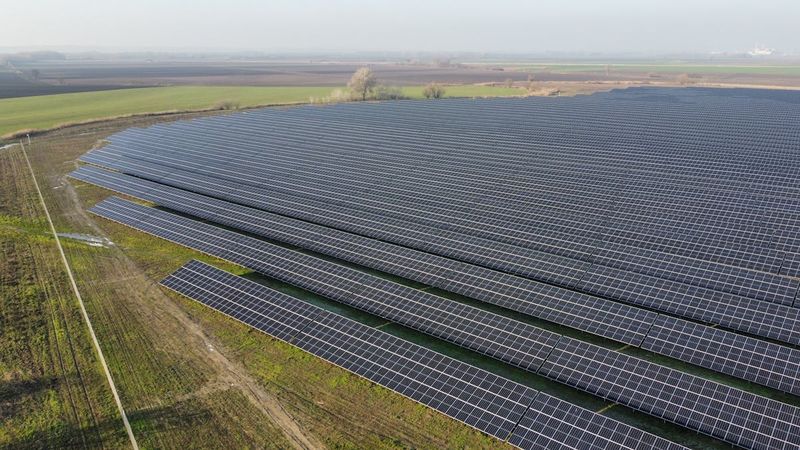
What followed was the most aggressive energy build-out any country has ever attempted. By the end of 2025, China’s installed wind and solar capacity reached 1,840 gigawatts. Solar alone hit 1,200 GW, up 35 percent year-on-year. Renewables now account for over 60 percent of total power generation capacity. Add 66 GW of new battery storage and coal production running at historic highs, and the picture is one of relentless diversification.
Simultaneously, China amassed oil it hoped it would never need. State firms added aggressively to storage in the months before the crisis. Strategic and commercial stockpiles reached an estimated 1.4 billion barrels — triple U.S. levels — enough to cover roughly six months of lost Middle Eastern imports.
The Dividend
Since U.S. and Israeli strikes on Iran effectively shut down Hormuz on February 28, Brent crude has surged past $100, reaching nearly $120. The International Energy Agency authorized a record 400-million-barrel drawdown from emergency reserves — which, at current global consumption of 105 million barrels daily, covers less than four days.
Eighty percent of the oil that normally transits Hormuz is headed for Asia. Japan, which sources 90 percent of its crude from the Middle East, has tapped national reserves. South Korea, dependent on the Gulf for 70 percent of its crude, is capping fuel prices. Thailand has ordered state agencies to work from home and imposed diesel price caps. Vietnam has fewer than 20 days of reserves on hand.
China’s exposure looks nothing like this. Oil shipments through Hormuz account for just 6 to 7 percent of its total energy consumption — a share that shrank as renewables expanded and pipeline gas from Russia replaced seaborne imports. The math has changed.
Markets have noticed. The CSI 300 has slipped 3.1 percent since the strikes began, compared with declines of at least 4 percent for the S&P 500, Euro Stoxx 50, and Japan’s Nikkei 225. Japan’s benchmark has fallen 7 percent; South Korea’s, 10 percent. In previous oil disruptions between 2011 and 2025, the CSI 300 fell by an average of 8.4 percent and underperformed global peers, according to South China Morning Post analysis. This time, it is outperforming. The difference is structural.
The CSI 300 Energy Index has climbed roughly 8 percent since late February, with renewables manufacturer Jinko Solar jumping 11 percent in Shanghai. “Chinese asset classes are something that is missed by global investors as a safe haven,” Cary Yeung of Pictet Asset Management told Energy Connects.
Follow the Money
The numbers behind China’s position are not subtle. Investment in major energy projects topped 3.5 trillion yuan in 2025 — roughly $500 billion — an 11 percent increase and the first time annual spending reached that threshold. China added 430 GW of new wind and solar in a single year, eight times what the United States installed. Electric and hybrid vehicles now outsell combustion-engine cars in the domestic market. According to Carbon Brief analysis, clean energy drove more than a third of China’s GDP growth in 2025.
None of this was charity. It was industrial policy executed at a scale only a state-directed economy can manage, driven by a calculation that energy dependence is a national security vulnerability. The Strait of Hormuz just proved the calculation correct.
Energy strategist Naif Aldandeni described the IEA’s record release as “a small bandage on a large wound.” For most of Asia, that assessment is generous. For China, the wound is smaller, the bandage optional, and the patient was already diversifying the blood supply.
Sources
- How the War With Iran Is Impacting Economies in Asia — Time
- Middle East war shockwaves ripple through Asia-Pacific — UN News
- China Emerges as Unlikely Haven as Oil Price Shock Hits Global Markets — Energy Connects
- Strategic oil release may calm markets but cannot fix Hormuz disruption — Al Jazeera
- China has been preparing for a global energy crisis for years — The Guardian
- Chinese stocks shake laggard image amid oil shock as green transition pays off — South China Morning Post
- China Adds Power 8x More Than the US in 2025, with $500B Energy Build-Out — Carbon Credits
- Clean energy drove more than a third of China’s GDP growth in 2025 — Carbon Brief
- ‘Europe learned the wrong lesson’ by doubling down on fossil fuels — Euronews